I took IWW’s Organizer Training 101: Build the Committee course in January when the opportunity to take it in person at my local GMB presented itself. I wasn’t sure what to expect, but had a vague sense of wanting to “do more” or at least learn more when it came to labor organizing and aligning myself with the values and operations of my fellow workers, not just at the IWW but in society in general; this has been a larger pursuit for me for the last decade or so, and I find myself, increasingly so the older I get, constantly searching for lenses through which to focus this desire to help things get better. When I joined the IWW I was hoping I was signing on to a cause that could take this impulse to the next level, so naturally organizer training seemed like a foundational building block.
I’m not exactly sure that I’m the ideal candidate for organizer training. I am self-employed, a contractor who works from home and never sees fellow workers, someone who files his 1040-SR every three months (uh, roughly) and can’t take sick days, has no health care, and enjoys zero job protection and exists entirely at the whim of some faceless middle manager in accounting. Well, wait, maybe I am the ideal candidate for organizer training. I may not be able to directly affect my own work environment, but I can certainly help others articulate and define their own needs and concerns, and learn to advocate for them effectively even if I’m not actively changing my own material conditions. And that was the attitude I took with me to Rhizome House in January.
I have spent a lifetime enduring forced retreats and dry, corporate “learning sessions” or “retreats” where the primary lessons learned involved crafting a plausible excuse for not attending; I have also been to weird raves in the desert involving flamethrowers and a head full of peyote. I wasn’t sure which way this one was going to lean but I was hoping I wouldn’t have to inveigle a revolt this early in my IWW tenure.
Thankfully the Fellow Workers from Detroit were competent, professional and dedicated to keeping the operation on rails. Right from the start I sensed that this marathon sessions, 14 hours over two days, was going to zoom by. Starting with the basic assumption that “You are a worker, and as a worker you are a person who deserves rights, and that begins with the right to organize,” we plunged into the work of building a committee at your own workplace, starting with yourself and slow expanding outward.
The trainers worked together nicely, building points off of each other respectfully, and always allowing comments or differing interpretations from attendees. Frankly it was a lot of information to get through, but at each stage where a new concept was introduced, we were broken into small groups (or more often simply asked to turn to the person sitting next to us) and asked to roleplay the situation that had just been examined by the instructors. And from both sides of the conversation. So not only were we absorbing this information by actually acting it out, we were usually being tasked with seeing the opposite viewpoint, so we could empathize better with people who might not want to hear the message. Usually these roleplay sessions involved recruiting people at your workplace to discuss issues involving that office or shop without coming off as a heavy-handed labor goon, or just as importantly, without tipping off management that an attempt to organize was underway and setting off their alarms too early in the process. We learned the delicacies of introducing what should be normal but still and too often in this country reads as “radical,” this idea that all workers deserve protection and dignity, into a capitalist ecosystem that, as always, defines value purely on the basis of profits and ignores that profits are created by people.
Anyway, I now know that you can foment a workplace revolution in a Subway sandwich shop thanks to our trainers. I am fairly confident after this training that I could convince a crypto tech bro to demand better material conditions.
Continuing on from the one-on-one sessions, we later broke out into larger groups, including one where we staged a walkout on an unsuspecting boss who had just eliminated workplace breaks. That was wildly cathartic and I thank one trainer for allowing me to focus decades of suppressed boss rage on a fellow worker by proxy for a few minutes.
The team-building is real, btw. Take OT 101 and you’ll swiftly reach a point where you’re ready to fall on a grenade for these people you just met 27 hours ago. I would have walked past you on the street yesterday and today we’re the crew of the IWSS Intersectional, on a five-year mission to organize all the things.
The pacing, again, was perfect, the segue from one section to the next presented in a logical, comprehensive way, and weirdly super orderly for prima facie anarchists. Like watching a fish walk, but maybe that’s a skill we’ll all need to teach ourselves to get through these strange times.
Thanks again to our Fellow Workers for guiding us through the basic building blocks of organizing principles, thanks to the FWs at Northeast Ohio IWW GMB for setting it up, and thanks to the workers that make up the IWW most of all.
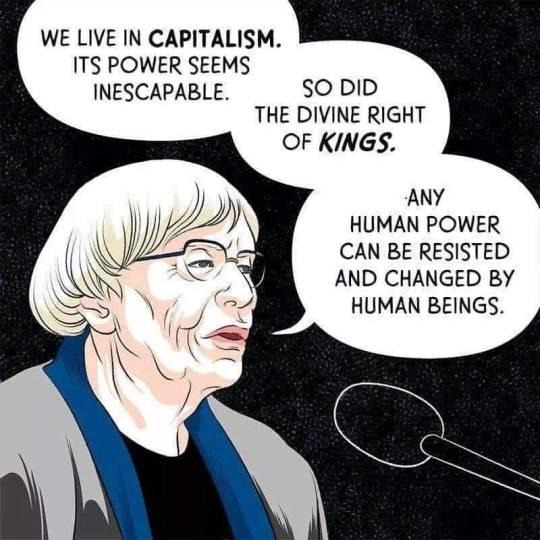
“We live in capitalism, it’s power seems inescapable. But then, so did the divine right of kings. Any human power can be resisted and changed by human beings. Resistance and change often begin in art. Very often our art, the art of words.” ~ Ursula K. Le Guin.
People take capitalism as an axiom, an unquestionable truth of life and existence. It’s not, and it never has been. The greatest lie told by capitalists is that it’s the default, and the greatest truth that can be told is that it isn’t.
In fact, there is no default. As the late David Graeber put it “The ultimate, hidden truth of the world is that it is something that we make, and could just as easily make differently.”
Humanity didn’t fall out of our tree and start building governments and systems of economics. We fell out of the tree and started foraging for the ripest, juiciest fruits and berries and the least bitter nuts. We fell out of our tree and started chasing the slowest antelope.
We kept chasing that antelope and foraging for berries for millennia before we established anything more complex than people living with each other and helping each other out. Helping each other get those nuts and berries and helping each other catch that antelope. We spent millennia just practicing mutual aid. Because the truth is, the only default humanity has isn’t capitalism, it’s mutual aid. Mutual aid is the bedrock of humanity, and the systems in place today are designed to see us forget that, but you can’t forget bedrock.
That urge to give a dollar to the homeless person on the street, that feeling in your gut when someone else is hurt, and that compulsion to help dig your neighbor out of their driveway in a snowstorm are all examples of the mutual aid ingrained in us from millennia of only having each other to rely on. These are all things that are disincentivized by the society in which we find ourselves.
Capitalism is designed to divorce you from the product of your labor. And to force you into needless competition with your fellow members of the working class. It’s designed to ingrain the idea that life is a zero-sum game deeply into your psyche. And as such, it’s designed to make you fight the instinctual urge to help out those around you.
The sole purpose of this entire socioeconomic system that’s been constructed around us right now is to prevent us from thinking too hard about why Elon Musk gets to be the richest man on earth while Joe Schmo is starving under an overpass. It’s designed to sow division and inhibit class consciousness. It’s designed to fuck you over in the name of the rich.
Our oppressors have shed the shackles of feudalism and monarchy. Monarchy was an intrinsically unstable system of economics and government for the wealthy because it was deeply centralized by virtue of its basis in a single powerful head of state. There was a single head to cut off the snake.
Under feudalism, it was less centralized but ultimately still had just the one head because there was still a king providing legitimacy to the feudal lords. Barons and heads of fiefdoms no matter how powerful they got, could never be more powerful than the king. They were dependent on the king as their source of legitimate systemic power. And so they overthrew the king.
Under capitalism the king has been replaced with capital. The source of legitimate systemic power has been decentralized. There’s no longer a wholly real and tangible source of abstract unquantifiable political power. It’s been replaced with a wholly abstract source of quantifiable political power. It can be quantified with a dollar value. The capacity to be quantified further legitimizes the power wielded by the ultra wealthy due to the apparent transparency provided by having hard numbers. Under capitalism, money is merely an exchangeable unit of political power. Money being an exchangeable unit of political power encourages and incentivizes the greed we see from the capitalist class.
The billionaires of today are collectively able to extract wealth at a scale the kings of old could only dream of. It’s turned from a snake into a hydra, there’s no longer a single head to cut off that collapses the entire system. Like Heracles, the solution to our hydra problem is to cut off the heads and cauterize the necks.
To cut off the heads we as the working class need to take the wealth back from these billionaires and hundred-millionaires, and to do that we need strong labor unions that ensure the working class receives the maximum possible share of the value of their labor. Ultimately, we need to cauterize the necks by replacing capitalism with an altogether more equitable system such as libertarian socialism or syndicalism.
The only paths forward are libertarian socialism or syndicalism, because they’re the only paths that will always ensure that the power remains in your hands as members of the working class.
Nonlibertarian forms of socialism have been attempted repeatedly, and every time a new ruling class asserts itself, and attempts to divorce the working class from the value of their own labor.
Syndicalism has also been tried, and repeatedly it’s demonstrated itself as an effective means of distributing power amongst the entire working class. The effectiveness displayed by syndicalism is why capitalists have repeatedly attempted to stamp it out under jackboot and truncheon. And the effectiveness of syndicalism is why it can never die. Syndicalism and libertarian socialism will be our path forward.
I won’t profess to know the solution, because I don’t. But I do know that our situation is untenable I, alongside many others, am tired of begging for extra scraps from the capitalist class when we’re the only ones actually doing anything. We shouldn’t have to beg for scraps, we should just take what’s ours. And what’s ours is everything, because we created everything. Labor is entitled to all it creates.
We live under capitalism, its cruelty is both intentional and absolute. And that cruelty comes primarily in the form of apathy and indifference. That apathy comes from the system itself and those who represent it. But it’s even forced into the souls of those who wish to simply live.
Capitalism steals everything from those it brutalizes. And I do mean everything, not just money, not just things, not just time. It steals concepts and emotions. No matter how fundamental something is, capitalism will steal it.
That includes simple joys like waking up in the morning and being ready and willing to greet the day. It’s difficult to wake up and appreciate the morning when you have to sell your body, mind, and soul for most of your waking hours with the expectation that you do it all again tomorrow.
It’s even difficult to simply appreciate the quiet moments when we’ve nothing to do because our tasks are complete. Quiet moments that once upon a time would be used for reflection and thought are now filled with dread for what comes next, dread for the exploitation we’re subject to.
And then while at work there’s no satisfaction to be had from a job well done because the reward for good hard work is more work. You’re actively disincentivized from caring about what you do, and you’re even further disincentivized from doing it especially well. Mere competence, but not exceptionalism is instilled into us due to the lack of reward for a job done well.
Beyond that, capitalism also robs us of things that are necessary to us. The capacity to grieve and mourn has been stolen from us, and ironically we’re unable to grieve that loss.
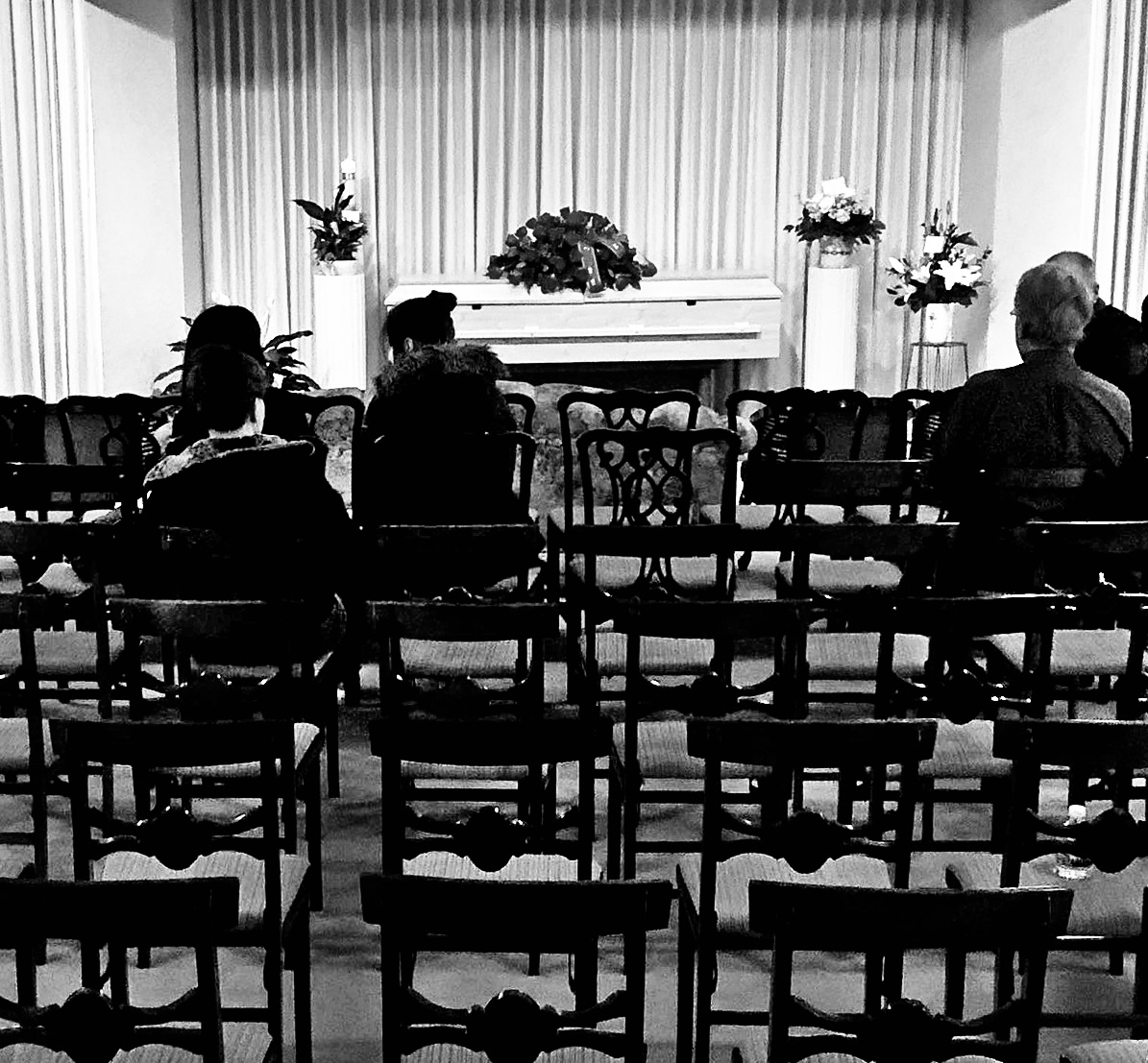
That capacity to mourn that we’ve had stolen from us is due to a combination of a system in which cruelty is the point and apathy which is built into the system to facilitate that cruelty. When someone we know and love dies, we don’t get to mourn how we ought, we don’t get to celebrate their life, we don’t get to stay sad about their death, we don’t get to treat death as anything but an inconvenience.
We’re sad for a day, if we’re granted the day off for the funeral at all, and then we’re forced to move on. The feelings linger, but we’re forced to put them on a shelf to be ignored. We tell ourselves that we’ll get to processing those feelings later, but that’s a lie. Because that’s not how it works. We’re forced to just keep working. All the while never working on processing our losses, and those losses are innumerable.
We’ve had our capacity to mourn stolen from us. Robbed of us by a class which seeks to parasitize us for their own benefit. A class which seeks to subjugate us to their will and desire, but never to allow us our own. Mourning has been killed by capitalism, but it can be resurrected.
An act as simple as taking time to grieve is an act of revolution when that act is disregarded as unproductive and inefficient. So please, mourn and grieve your losses in whatever way you deem appropriate; for we are all, each of us, individuals subject to a system of cruel oppression, but together we are a collective refusing to bow.
Dedicated to Staughton Lynd, friend of the union and Fellow Worker Forever.