by NEO IWW | Sep 29, 2023 | Poetry
THE GRIEVANCE
It’s Out of My Hands
The shop was like a sweat box,
The heat was ninety-three.
I had a little grievance,
As anyone could see.
I went to see the foreman
And called to him by name.
I asked him could he open up
That nailed-down window pane?
But my boss said, “It’s out of my hands.”
I asked to see my steward,
And the boss he did agree.
But for two more days, nor hide nor hair
Of either did I see.
I finally caught the foreman
As he was running by.
He said my message was delivered
To the proper guy.
And now it was out of his hands.
The steward, when I saw him,
Looked both shrewd and wise,
And told me how much more there was
Than seemed to meet the eyes.
He quoted several clauses,
Interpretations too.
Said that writing up a grievance
Was all that he could do.
Then it was out of his hands.
The Committeeman next came around,
Him I had never met.
The rest is strictly rumor
For I haven’t met him yet.
But the story, when I got it,
At third or second hand,
After many weeks of waiting,
I was made to understand-
It was out of his hands.
The next thing that I heard of,
Through the grapevine, tried and true,
It had reached the shop committee,
They’d see what they could do.
The days were getting shorter,
And fall was drawing near,
When the long-delayed decision I finally got to hear.
It was out of their hands.
I wish I could say
That this ended my ditty
But my case was referred
To the Screening Committee.
I was told I was lucky,
After months had gone by
That my grievance had not
Just been left there to die.
But it was now out of their hands.
The Umpire considered
And pondered and thought.
He was honest and upright
And could not be bought.
Of the one hundred grievances
We lost ninety-nine,
But the one that was salvaged
Turned out to be mine.
The window was opened
On a cold wintry day.
I shivered and shook
Till I thought I’d give way.
I went to the foreman
And called him by name,
And asked him to shut
That damned window pane.
But he said, “It’s out my hands.”
Martin Glaberman was an autoworker and Marxist historian. He wrote much about effective unionism based on his experiences in the workforce.

by x370051 | Sep 28, 2023 | Organizing
When you can’t organize widely, organize fast.
Recently we had a difficult lead in our branch. A fellow worker was at a small retail store, part of a large national chain. The store itself only had a few workers, typically between 3-5 on staff at any time, so they were trying to reach out broadly and get to know the other workers at nearby stores in the chain. But the turnover was constant, workers were moving between stores too often, anyone who had been there more than a few weeks was given manager titles (but not really any power or support). This was a difficult campaign.
One day while going through some old email lists from past organizers, I saw some advice I thought might help. “With high turnover and a lot of instability, it’s better to go fast than to go wide.” This sounded like good advice, so I texted the lead. “OK,” was the response. A few hours later, a second response: “OK, I took your advice and me and two other workers talked and we got the boss to rehire somebody. Fast enough?”
That was pretty fast. What happened was another worker had to quit because the job was just too stressful, the role they were in had certain metrics and reporting requirements that were triggering their anxiety. The shop needed the extra help, and that worker needed the hours, so the lead and their committee pressured the boss to not only rehire the worker, but to change the role so that it didn’t involve any of the reporting that was an anxiety trigger. Instead of trying to keep up with a broad, wide set of contacts and map out relations across several stores in the district, they went for fast, significant agitation and direct action. Not bad for a few hours’ work.
So what about the campaign itself? It was never going to be a long term job for the lead, or for any of their coworkers, but in just a few months the agitation kept up and the workers put together a number of direct actions. Issues like scheduling, hours, and the normal things retail workers have to struggle with were ample sources for agitation. Like too many low level district managers, theirs was often of the mindset, “If you have time to lean, you have time to clean,” and so there were no chairs in the store. No one could sit and rest, ever. In a very defiant moment of workplace conditioning, they brought out chairs and stepladders and all took their breaks, when needed, on the shop floor in clear sight of the store’s cameras.
But what did this short, fast campaign really accomplish? For one thing, it made these individual workers really feel their own power and reclaim some of their dignity. In this kind of everyday struggle with capitalists the lead and the workers get a taste of what it means to agitate and act as a class. The lead worker told us afterwards that “[i]n a good organizing drive people learn to lift their heads up. They start to feel their worth and stop begging, start demanding.”
I don’t think the struggle to sit down for breaks at Store #1312 of Generic Retail Chain will become the stuff of legends in Wobbly lore, but for these workers it was a real experience of the power a little organizing can bring, and an appetizer for what it tastes like when “we are forming the structure of the new society in the shell of the old.”
by NEO IWW | Sep 27, 2023 | Labor History, Reflections
I read a poem that blew my heart wide open like it was a balloon shot down by the Air Force. Would you let me tell you why?
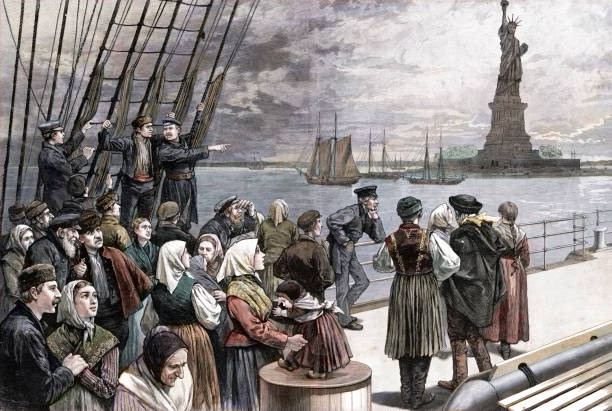
In the 1880s, there were over five million immigrants to the United States. There were four million more the next decade. Across the threshold of Ellis Island rushed the huddled masses, yearning to breathe free. But though they were promised a new world, they discovered one crueler than the old. The lofty promises which drew them to these shores, made by businesses and politicians, were never kept. Their American dream evaporated every morning at the dark sound of the work bell.
By 1900, the U.S. had deceived and captured a massive foreign workforce, trapping them in major cities like Boston, Cleveland, New York, and Philadelphia. Government quotas were specifically designed for this purpose.
After shipping these immigrants in boats no better or safer than what had carried over African slaves— indeed sometimes the very same boats— the government and big business worked together to shuffle them into new open prisons, into slums they called “cities.”
People were promised the world and left with pennies. Too poor to escape, the vast majority merely suffered. Crowded together like caged animals, they fought with each other. All the torments of drugs and alcohol and violence that come with such pain began to dominate communities. Speaking of my own family, these scars still persist.
Americans helped control immigrants because of their nativism, leaving immigrants isolated and more vulnerable to the worst excesses of capitalism. Immigrants were the new slave labor force. (Making this even clearer is the Supreme Court’s treatment of the 14th amendment. Only a handful of cases citing it were about Black people— hundreds were about the rights of corporations, now legally recognized as “persons.” The new law ostensibly designed to protect equality was like its predecessors used against it.)
This backfired often but not enough to break the cycle.
Immigrants were hired as strikebreakers because they cost less to hire and couldn’t talk to white strikers. White strikers usually resented them and would react accordingly. And since immigrants lacked any pay equality, bosses could easily use them to replace white workers.
Bosses used this to fuel further resentment between the various racial groups, telling white workers that immigrants were a threat to their jobs. (Do you see it? I hope you do.)
In 1880, there were more than 1.1 million child workers in the USA. That’s one out of six kids under sixteen— most often far under sixteen— working the same backbreaking 10 or 12 or 16 hour shifts as their parents. Hundreds of thousands were kidnapped into forced labor, just like their parents. Families didn’t see each other anymore. They couldn’t— to survive.
Families became strangers because of the god we call “Work,” slaving their lives out for some bourgeois jerk.
And a pants presser named Morris Rosenfeld wrote a poem, “My Boy,” and as I read it the last scales of “the immigrant America,” the final bits of all that old myth about the American dream and the land of prosperity and immigrants being so welcomed and desperate to come… fell as so much rusted scaffolding.
I have a little boy at home,
A pretty little son;
I think sometimes the world is mine
In him, my only one.
But seldom, seldom do I see
My child in heaven’s light;
I find him always fast asleep…
I see him but at night.
Ere dawn my labor drives me forth;
‘Tis night when I am free;
A stranger am I to my child;
And strange my child to me.
I come in darkness to my home,
With weariness and-pay;
My pallid wife, she waits to tell
The things he learned to say.
How plain and prettily he asked:
“Dear mamma, when’s ‘Tonight’?
O when will come my dear papa
And bring a penny bright?”
I hear her words-I hasten out-
This moment must it be!-
The father-love flames in my breast:
My child must look at me!
I stand beside the tiny cot,
And look, and list, and-ah!
A dream-thought moves the baby-lips:
“O, where is my papa!”
I kiss and kiss the shut blue eyes;
I kiss them not in vain.
They open,-O they see me then!
And straightway close again.
“Here’s your papa, my precious one;-
A penny for you!”-ah!
A dream still moves the baby-lips:
“O, where is my papa!”
And I-I think in bitterness
And disappointment sore;
“Some day you will awake, my child,
To find me nevermore.”
I hear my grandfather’s voice, my great-grandfather’s voice, crying out in the wilderness. For today their voices continue in other tongues. Today, another grandfather and great-grandfather cry out, “My boy!” And their boy cannot see them.
But today Americans still cannot hear them. They are too insulated in their HOAs and do not speak those ‘foreign’ languages. They cannot hear fathers and mothers crying in the night. Over the din of the social circus, the acceptable white American does not hear the inconsolable voice of Rachel weeping for her children— “for her children are no more.”
One day, desperate to control newer and even less pale-skinned immigrants, the whites told my fathers that we too can be white. A bribe was offered. And white we became, forgetting just how unwelcome in whiteness we once were.
So for skin color and crumbs of privilege we have forgotten just who we are and what White America also did to us. Or that we are now doing it, too. That we are a part of it. We do not realize we are now the tools of greed and hate, repeating the very crimes committed against us.
We are the same! If you can only see it, how we are all the same. If I could reach out of the sky and pull it down for you, to show you, you would see, but I cannot. Have you seen it, too? Does it also make you shake?
The Emperor Constantine looked to the heavens for a sign and saw a flaming chi rho, a trophy burning with glory, but his eyes were blurred by the haze. I see no chi rho. There is no glorious fire above. I look at the sky and see a wicked gnarled cross, and my father is on it, my grandfather, and his father, and my mother and grandmothers, and their mothers and fathers, and each time ‘their boy’ stands at the foot to await his turn.
A fire burns not in the sky but in my belly. I think it will eat me up.