At the 3/12 General Membership Branch meeting, the Northeast Ohio IWW voted to approve the following resolution in support of the Railroad Workers United push for public ownership of U.S. railroads. While the resolution is a statement of support, it is also a powerful and detailed indictment of the rail industry. It states the case for public ownership and democratic worker control of North America’s rail industry in clear language. The resolution reads as follows:
Whereas, rail infrastructure the world over is held publicly, as are the roads, bridges, canals, harbors, airports, and other transportation infrastructure; and
Whereas, numerous examples of rail infrastructure held publicly have operated successfully across North America for decades, usually in the form of local/regional commuter operations and state-owned freight trackage; and
Whereas, due to their inability to effectively move the nation’s freight and passengers during WWI, the U.S. government effectively nationalized the private rail infra-structure in the U.S. for 26 months; and
Whereas, at that time it was agreed by shippers, passengers, and rail workers that the railroads were operated far more effectively and efficiently during that time span; and
Whereas, every rail union at that time supported continued public ownership (the “Plumb Plan”) once the war had ended; and
Whereas, specifically, when the rank & file rail workers were polled by their unions in December 1918, the combined totals were 306,720 in favor of continued nationalization with just 1,466 in favor of a return to private ownership; and
Whereas, the entire labor movement at that time was in favor of basic industry being removed from private hands, with the delegates to the 1920 AFL Convention voting 29,159 to 8,349 in favor, overruling the officialdom of the AFL and its conservative position; and
Whereas, in the face of today’s crumbling infrastructure, crowded and clogged highways and city streets, poor air quality, lack of transportation alternatives and deepening climate crisis, expanded rail transportation – for both freight and passenger – presents a solution to these social ills and problems; and
Whereas, the rail industry today however is contracting – rather than expanding – at a time when we need more trains, trackage, rail workers, and carloads, not fewer; and
Whereas, the private rail industry is moving 5 to 10% less freight than it did 16 years ago, and in recent years has shuttered diesel shops and classification yards, and has drastically reduced the number of employees; and
Whereas, the private rail freight industry is generally hostile to proposals to run any additional passenger trains on their tracks – despite having legal common carrier obligations to do so – making it difficult if not impossible to expand the nations’ passenger rail network; and
Whereas, the rail industry has come to focus solely on the “Operating Ratio” as a measure of their success, and in doing so have engaged in massive stock buybacks and other measures that deliver short-term gains for stockholders but at the expense of the long-term health and vitality of the industry; and
Whereas, the Class One carriers’ failures to move freight effectively have contributed greatly to the ongoing supply chain crisis, resulting in some of the highest inflation rates in many years; and
Whereas, these “Fortune 500” corporations have raked in record profits, in both “good” years and “bad”, right through the “Great Recession,” the pandemic, and otherwise, right up to the most recent Quarterly financial announcements; and
Whereas, during these years of record profits, these same Class One carriers have:
• Failed to solicit nor accept new but “less profitable” freight traffic.
• Forwarded less freight than 16 years ago.
• Stonewalled practically every attempt by Amtrak and other agencies to add passenger service.
• Failed to run Amtrak passenger trains on time, despite regulation and law to do so.
• Downsized the infrastructure, physical plant, and capacity.
• Eliminated nearly a third of the workforce.
• Outraged shippers and their associations by jacking up prices, providing poor service, and
• Assessing new demurrage charges.
• Thumbed their nose at state and federal governments.
• Blocked road crossing and increased derailments by the implementation of extremely long trains.
• Threatened and attempted at every turn to run trains with a single crew member.
• Opposed proposed safety measures, from Positive Train Control (PTC) to switch point indicators;
• The End-of-Train Device (EOT) to Electronically Controlled Pneumatic Brakes (ECP).
• Taken a hostile stance towards the myriad unions, refused to bargain in good faith, consistently demanding concessions, all the while expecting these “essential workers” to labor through the pandemic without a wage increase.
Therefore, Be It Resolved that the NORTHEAST OHIO IWW GENERAL MEMBERSHIP BRANCH supports the public ownership of the rail infrastructure of the U.S., Canada, and Mexico, under democratic workers’ control, to be operated henceforth in the public interest, placed at the service of the people of all three nations; and
Be it further resolved that the Northeast Ohio IWW GMB supports the Rail Workers United movement for public ownership, and,
Be it Further Resolved that the NORTHEAST OHIO IWW GENERAL MEMBERSHIP BRANCH urges all of its members to voice their support for this proposal; and
Be it Further Resolved that the NORTHEAST OHIO IWW GENERAL MEMBERSHIP BRANCH urges all other IWW branches, industrial unions, and chartered bodies to take a similar stand; and
Be it Finally Resolved that the NORTHEAST OHIO IWW GENERAL MEMBERSHIP BRANCH urges all labor unions, environmental and community groups, social justice organizations, rail advocacy groups and others to push for a modern publicly owned rail system, one that serves the nation’s passengers, shippers, communities, and citizens.
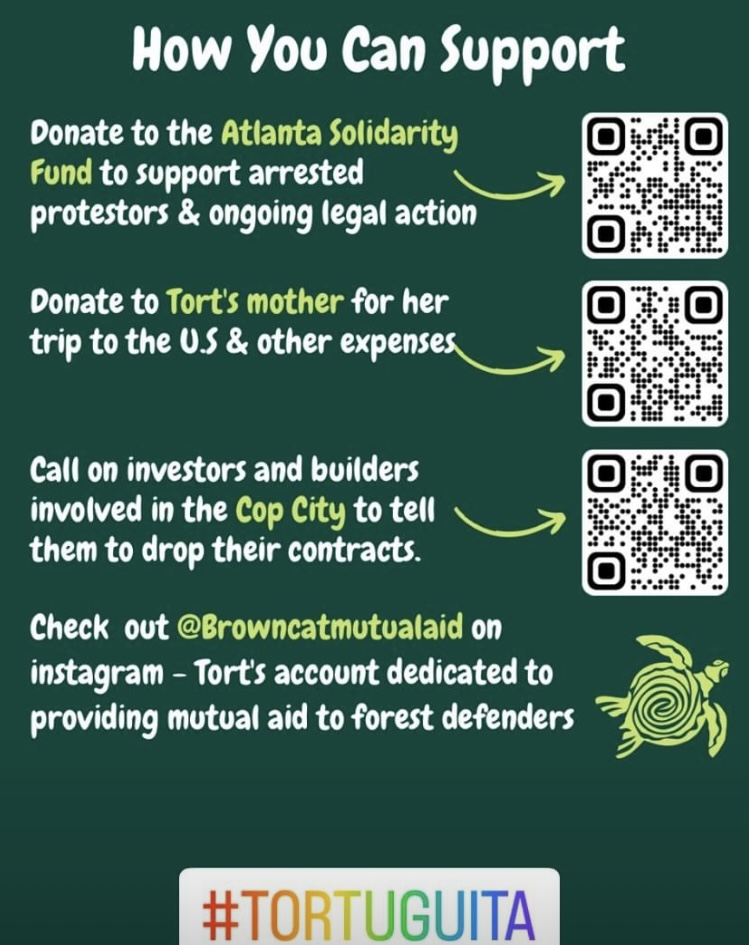
On January 18, 2023 eco-activist and Fellow Worker Tortuguita was murdered by the police. Tortuguita died in defense of the working class and the earth. They carried no weapon but their will, kept no home but a tent, felt no desire but to save Atlanta’s Weelaunee Forest from destruction. Their reward was shameless brutality.
Tortuguita’s stand was not against any ordinary industrial destruction, but a bulldozing to make way for a heinous police training facility aptly nicknamed “Cop City.” This project is another step in the ruling class’s plan to strip even more common folk of healthcare, education, childcare, public transit, food, free speech and free movement.
We have the same choice now as before: to take this violence lying down or to create a new society of peace. This society must be organized by you, by me, by all of us together. There is no replacement for the daily work of building it up. We all have the responsibility to grow this solidarity movement wherever we are right now.
Mourning is natural for those who lose someone they love. For the working class at large, we must take these events for what they are: an impetus for us all to take up anew the struggle that fate has placed before us. What is our response to repression? To organize against it. To organize for better. This is what keeps every victim of capitalism from having died in vain.
Rest in power, Fellow Worker Tortuguita.
May their family, friends, and comrades find peace. To the rest of us: don’t let Tortuguita’s death be in vain. Don’t waste any time mourning— organize!
For more information on FW Tortuguita and the fight against “Cop City,” please see these resources:
Please bring materials to help build a memorial to our fallen, if you are able. Wear black, wear a mask, and feel free to bring offerings for the dead.
Since our founding in 1905, the IWW has struggled for the rights of the entire working class. Northeast Ohio Wobblies in particular have a long history of especially intense solidarity. The Northeast Ohio IWW has long stood hand in hand with our fellow workers. From the fight for better working conditions at the Cleveland May Day Uprisings, to organizing tinners and slaters, cigar rollers, fence makers, rubber and steel workers, coal miners and machinists, we have been there with all our might through each triumph and defeat for our local working class.
No politician or government has the right to impede workers’ struggles, especially the inviolable right to strike. As such, we will support and respect any decision made by the railroaders in the face of the severe and unjustifiable government repression of their rights as workers. It goes without saying that we hold no such respect or support for the U.S. President or his Congress, who have once again played their role as workers’ enemies in the class struggle. No “law” violating workers’ rights is worth the paper used to print it.
As workers, we have the right and duty to organize our industries as we see fit. It is our work and our lives in question, as always. Members of the Northeast Ohio IWW continue to stand in solidarity with our fellow workers, knowing as we do that labor is entitled to all that it creates. Our membership is actively following updates from the Railroad Workers Rank and File Committee (RWRFC) and seeking ways to show material support in the coming days.
According to Darryl Cooper, he’s not an historian. He is, however, curious, passionate and open minded. He also appears to be a glutton for punishment in the form of research at sheer unimaginable volumes. Don’t believe it? Darryl Cooper’s podcasts are long form. Perhaps that should be LONG form… But damn are they good!
It’s hard to say what was going on in his mind when he decided to create a series of lectures on Labor history in the United States. It’s a daunting process, as many Fellow Workers know, trying to sort out the facts from the bullshit. What really went down between the IWW and the authorities? Why didn’t anyone tell us about this in school? Is this why my coal mining grandfather routinely cursed the public school system when he reminded us that our religion was “the union”?
Labor History as Real Life
Some characters in this story will be familiar, but Cooper has gone out of his way to string together the histories of workers, politicians, wives, children, migrants and law enforcers so that we might get to know them as people, rather than mentions in the stories of the famous organizers. He’s stated this is a story near to his heart and it’s easy to tell which side Mr. Cooper is on. As with all his subjects, however, he presents as many facts as possible.
Please enjoy the first two episodes of Whose America. We will be updating these as they are released. You can find Mr. Cooper at https://martyrmade.com/ and https://martyrmade.substack.com/. The podcast can also be found on most podcast apps & feeds. We hope to interview him soon regarding this project and the future of the IWW.
Whose America: Prologue
In August 1921, 10,000-20,000 armed coal miners marched on Mingo County, West Virginia to lift the martial law imposed there, free their jailed brethren, and avenge the assassination of one of their local heroes. At least 20,000 more wives, young boys and other civilians followed the army providing medical, logistical and other services. Before it was over, they would storm a mountainside under fire from entrenched machine guns, and while being bombed from the air. It was the largest and most serious armed insurrection in US history since the Civil War. This episode is going to discuss the West Virginia Coal Mine Wars, and The Battle of Blair Mountain.
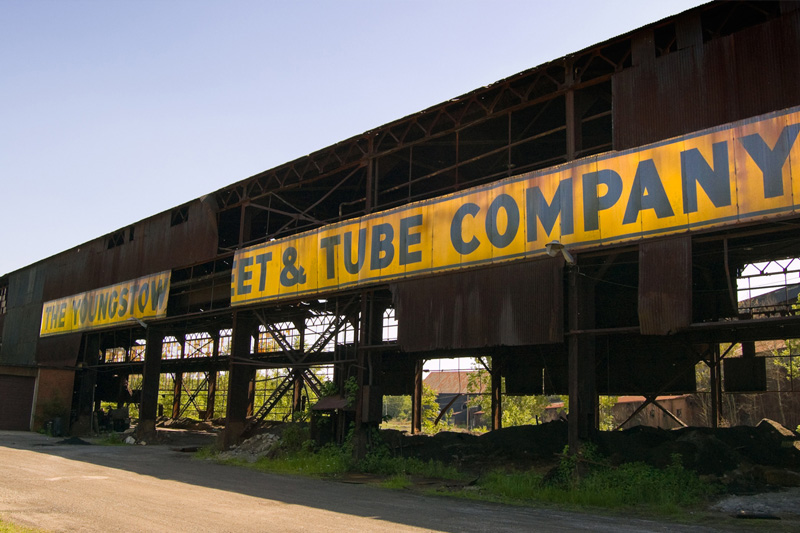
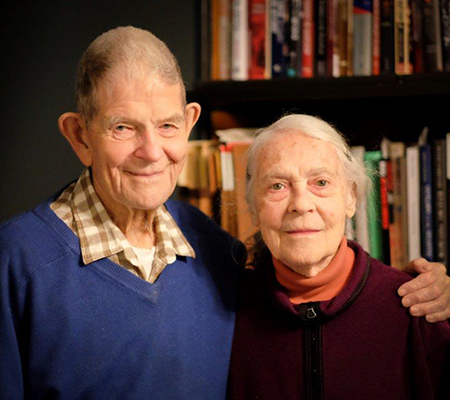
Come join the Northeast Ohio Industrial Workers of the World for a film event and discussion unlike any other–featuring the inestimable radicals, Alice and Staughton Lynd! Our local union is proud to host a showing of Shout Youngstown, the remarkable documentary on the community fight to save Youngstown’s steel mills.
Be a part of an evening of education and reflection on some of our area’s most dramatic labor history, as the Lynds walk us through their experiences and what modern working people can learn from our past. Join us for a night of working class education and solidarity!
Alice and Staughton are longtime working class activists who have been based in Northeast Ohio since the late 1970s. Staughton and Alice were instrumental in providing Youngstown steelworkers with legal aid, tactical advice, and fostering solidarity between local working people. They were prominent voices in the anti-war and civil rights movements, who have continued to struggle alongside working people for decades.
What’s Shout Youngstown!?
Shout Youngstown is a short documentary film depicting the fight to save Youngstown’s steel industry from corporate greed. It features interviews with numerous figures instrumental in the fight. This film shows the struggle to save the mills, but vitally the solidarity between Youngstown workers, families, and advocates in the face of overwhelming corporate and government opposition.
The film’s name comes from a song by unionist Joe Jencks, “I Will Shout Youngstown.” The first verse goes:
What can I tell you
Tell me what can I say
All the mills standing silent
All the jobs gone away
Now the storefronts are empty
As I walk up and down
But everywhere I go
I will
Shout Youngstown!
What you can expect:
Good times, a rare local film, laughter and tears, an atmosphere of solidarity, singing union songs, and lessons from our history you can’t afford to miss!